Lambda-CDM model
Standard cosmological model of dark energy and cold dark matter.

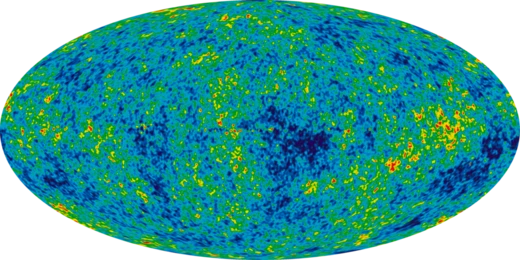
The Lambda-CDM (ΛCDM) model is the standard form of the Big Bang theory of cosmology, governing the chronology of the universe. It postulates a cosmological constant (Λ) associated with dark energy, cold dark matter (CDM), and ordinary matter, and is the simplest model that accounts for the cosmic microwave background, large-scale structure, light-element abundances, and the accelerating expansion of the universe.
- field
- Cosmology
- known_for
- Standard model of Big Bang cosmology incorporating dark energy and cold dark matter
- components
- Dark energy (Λ), cold dark matter (CDM), ordinary matter
- dark_matter_fraction
- ~26.5% of mass-energy density
- ordinary_matter_fraction
- ~4.9% of mass-energy density
Lore & Background
The model includes cosmic inflation to produce perturbations, which are characterized by additional parameters matched to observations. The light from astronomical observations passes through ionized space, where electrons can scatter it, altering anisotropies. The expansion of space is documented via redshift of spectral lines and time dilation in supernova light curves, attributed to a Doppler shift as light travels across expanding space. The expansion allows distant galaxies to recede faster than light, though local expansion is subluminal.
Reader's Guide
The ΛCDM model has been successful in modeling a broad collection of astronomical observations over decades, including the cosmic microwave background, large-scale structure, light-element abundances, and the accelerating expansion. It proposes cold dark matter as non-baryonic, cold, dissipationless, and collisionless, interacting only through gravity and possibly the weak force. Dark matter constitutes about 26.5% of the mass-energy density, while ordinary matter makes up 4.9%, with most ordinary matter unseen. The model's remaining issues challenge its assumptions and have led to many alternative models. The earliest epoch supported by observational evidence is cosmic inflation, followed by reheating and the hot Big Bang. Cosmic inflation addresses the horizon problem, and the universe may be larger than the observable particle horizon.
Did You Know?
- The ΛCDM model emerged in the late 1990s as a concordance cosmology after a period of inconsistent observations.
- Cold dark matter is hypothesized to be non-baryonic, cold, dissipationless, and collisionless.
- The model allows for distant galaxies to recede from each other at speeds greater than the speed of light.
More in Cosmology Concepts 1-24
Elsewhere in the Cosmology Concepts universe
Spotted an error? Know more?
This is a living reference — every entry is fact-audited, and reader corrections feed straight into our audit queue. Suggest an edit · See this site's audit record