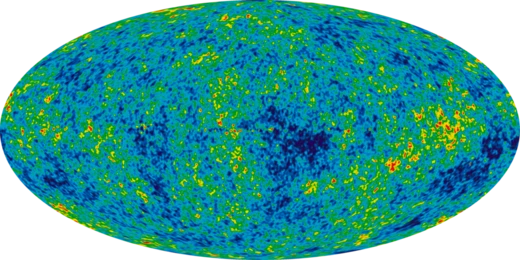
Photon epoch
Epoch when photons dominated the early universe's energy.

The photon epoch was a period in the evolution of the early universe, occurring after the lepton epoch, during which photons dominated the energy of the universe. During this epoch, the universe consisted of a hot, dense plasma of nuclei, electrons, and photons. The bulk of Big Bang nucleosynthesis actually took place during the preceding lepton epoch and the first few minutes of the photon epoch, rather than throughout the entire epoch.
- start
- ~10 seconds after the Big Bang
- field
- Physical cosmology
- key_process
- Big Bang nucleosynthesis
- dominant_component
- Photons
- legacy
- Creation of primordial abundances and cosmic microwave background radiation
Lore & Background
The photon epoch began after most leptons and anti-leptons were annihilated at the end of the lepton epoch, about 10 seconds after the Big Bang. At its start, many photons had sufficient energy to photodissociate deuterium, causing atomic nuclei that formed to quickly separate back into protons and neutrons. By the ten-second mark, fewer high-energy photons were available, and the abundance of deuterium nuclei began to increase. Nucleosynthesis effectively ended around 20 minutes after the Big Bang, when the temperature dropped below about 0.1 MeV (roughly 1 billion Kelvin).
Reader's Guide
The photon epoch is significant because it encompasses the period of Big Bang nucleosynthesis, during which the first atomic nuclei—including deuterium, tritium, helium-3, helium-4, and trace amounts of lithium and beryllium—were formed. This process set the primordial abundances that provide checks on physical models of the early universe. The epoch ended when the temperature dropped below 0.03 MeV, halting nucleosynthesis. This transition, known as the surface of last scattering, marks the end of the photon epoch and the beginning of structure formation.
Did You Know?
- The photon epoch started about 10 seconds after the Big Bang, after most leptons and anti-leptons were annihilated.
- Atomic nuclei were created primarily during the earlier lepton epoch and the first few minutes of the photon epoch, including deuterium, tritium, helium-3, helium-4, and trace amounts of lithium and beryllium.
- Nucleosynthesis ended when the thermal energy dropped below about 0.1 MeV (around 1 billion Kelvin), roughly 20 minutes after the Big Bang.
Origins: From Planck's Chunks to Einstein's Quanta
The modern understanding of light as a discrete quantum entity traces back to the early 1900s, when two physicists working in different directions converged on a revolutionary idea. Max Planck, grappling with the problem of thermal equilibrium between matter and electromagnetic radiation, proposed that energy stored within a material object comes in fixed, equal-sized chunks rather than a continuous flow. Building on that groundwork, Albert Einstein took a bolder step: to account for the photoelectric effect, he argued that light itself is not a smooth wave but a stream of individual energy packets. This bold reinterpretation was later confirmed by numerous independent experiments. The very word 'photon' entered scientific vocabulary in 1926, when Gilbert N. Lewis championed the term for these discrete units. The name itself descends from the Ancient Greek phôs, meaning light, a linguistic thread stretching back millennia before the physics finally caught up with the language.
Physical Identity: A Massless Boson with No Charge
The photon occupies a singular position among elementary particles. It carries no electric charge, possesses zero rest mass, and is fundamentally stable, with an experimental upper mass bound on the order of 10 to the minus 53 grams and a lifetime exceeding 10 to the 18th power years, vastly outlasting the roughly 13.8 billion-year age of the universe. As a boson, it obeys Bose–Einstein statistics rather than Fermi–Dirac statistics, meaning the Pauli exclusion principle does not apply; unlimited numbers of photons can pile into the same quantum state. In vacuum, a photon travels at exactly the speed of light and can exist in two polarization states. It is the gauge boson mediating the electromagnetic interaction, and all other quantum numbers—lepton number, baryon number, flavour—vanish. It also carries spin angular momentum of either plus or minus ħ, corresponding to the two circular polarization states, while collections of photons in a beam may display mixed or linear polarization.
Energy, Momentum, and the Relativistic Framework
In quantum mechanics, a photon's energy is locked to its frequency through the relation E equals hν, where h is the Planck constant. Equivalently, one can express that energy using angular frequency or wavelength, yielding E equals ħω or hc over λ. The photon's momentum points along its direction of travel and has magnitude hν over c, or h over λ, directly proportional to the wave number. Because the photon is massless, its energy and momentum satisfy the special-relativistic relation E squared equals p squared c squared, with the rest-mass term simply dropping out. This elegant consistency between quantum and relativistic descriptions underscores why the photon sits at the intersection of two foundational theories. Photons are produced whenever a charged particle accelerates and emits synchrotron radiation, or when an atom, molecule, or nucleus drops to a lower energy level, releasing characteristic energies spanning the entire spectrum from radio waves to gamma rays. Particle-antiparticle annihilation, such as electron-positron collisions, also generates photons.
Legacy: From the Standard Model to Quantum Computing
Within the Standard Model, the photon is not an arbitrary addition but a necessary consequence of gauge symmetry at every point in spacetime; the intrinsic properties of all elementary particles, including charge, mass, and spin, flow from these symmetry principles. The photon concept has catalyzed some of the most consequential advances in modern physics, from the invention of lasers and the realization of Bose–Einstein condensation to the development of quantum field theory and the probabilistic interpretation of quantum mechanics. Its practical reach extends into photochemistry, high-resolution microscopy, and precise measurements of molecular distances. In the twenty-first century, photons have become central to quantum computing architectures, optical imaging systems, and optical communication protocols, including quantum cryptography. As the mediator of the electromagnetic interaction and a quantum of the electromagnetic field encompassing everything from visible light to radio waves, the photon remains one of the most versatile and far-reaching concepts in all of science.
Frequently Asked Questions
What is the Photon epoch?
The Photon epoch is the stretch of early-universe history in which photons carried the majority of the total energy. It followed the lepton epoch and marked a period when radiation, rather than matter, set the cosmic tone.
When did the Photon epoch begin and end?
It kicked off roughly ten seconds after the Big Bang, right after the lepton epoch wrapped up. It persisted until matter's energy density finally overtook that of radiation, transitioning the universe into the matter-dominated era.
What was the universe made of during the Photon epoch?
The cosmos was essentially a searing, dense plasma of atomic nuclei, free electrons, and a bath of photons all jostling together. Nothing had yet settled into neutral atoms or any larger structures.
Did Big Bang nucleosynthesis happen entirely during the Photon epoch?
Not quite—most of the light-element forging actually occurred during the tail end of the lepton epoch and the first few minutes of the photon epoch. So while the photon epoch overlaps with nucleosynthesis, it was not the sole stage for that process.
Why is the Photon epoch important to modern cosmology?
It locked in the primordial abundances of light elements we still measure today and set the thermal stage for the cosmic microwave background radiation that now fills the sky. Without that radiation-dominated era, the observable thermal history of the universe would look very different.
More in Cosmology Concepts 25-39
Elsewhere in the Cosmology Concepts universe
Spotted an error? Know more?
This is a living reference — every entry is fact-audited, and reader corrections feed straight into our audit queue. Suggest an edit · See this site's audit record