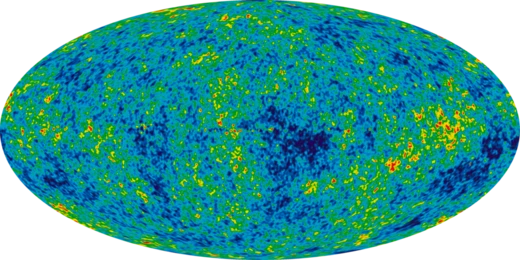
Chronology of the universe
Standard timeline of cosmic history from inflation to present.

The chronology of the universe describes the history and future of the universe according to the current understanding of physical cosmology. It begins with inflation, the earliest stage supported by observational evidence, which occurred 13.8 billion years ago, and proceeds through the Big Bang, nucleosynthesis, formation of atoms, stars, and galaxies, to the present era of dark energy dominance.
- Earliest supported stage
- Inflation, 13.8 billion years ago
- Key events
- Big Bang, baryogenesis, nucleosynthesis, recombination, star formation, dark energy dominance
- Duration of inflation
- Between 10⁻³³ and 10⁻³² seconds
- Expansion factor during inflation
- At least 10²⁶
- Time of nucleosynthesis
- Within first three minutes
- Current era
- Dark energy dominated, accelerated expansion
Lore & Background
Gravitational collapse of atomic gas then ignited nuclear fusion, creating the first stars, and over millions of years formed galaxies and larger structures. After a further nine billion years, the universe transitioned from matter-dominated to dark energy-dominated, leading to accelerated expansion. Many modifications to the standard timeline have been proposed, especially before Big Bang nucleosynthesis, due to lack of direct observational evidence.
Reader's Guide
The chronology of the universe is the foundational framework for modern cosmology, integrating particle physics and general relativity to explain the evolution of the cosmos from its earliest observable moments. It provides a testable sequence of events—inflation, baryogenesis, nucleosynthesis, recombination, structure formation, and dark energy dominance—that aligns with key observational evidence such as the cosmic microwave background and the abundance of light elements. The timeline highlights the interplay between expansion, cooling, and particle interactions, and underscores the role of inflation in generating large-scale structure from quantum fluctuations. While the standard chronology is well-supported, the article notes significant uncertainty about processes before nucleosynthesis, including the mechanism of inflation and the production of dark matter. This openness to modification reflects the dynamic nature of cosmology, where theoretical models continue to evolve as new data emerge. The chronology thus serves both as a summary of current knowledge and as a guide to unresolved questions, making it essential for understanding the universe's past and future.
Did You Know?
- Inflation expanded the universe by at least a factor of 10²⁶ in about 10⁻³⁶ seconds.
- Big Bang nucleosynthesis within the first three minutes produced hydrogen, helium, and a small amount of lithium.
- The universe transitioned from matter-dominated to dark energy-dominated after about nine billion years.
More in Cosmology Concepts 1-24
Elsewhere in the Cosmology Concepts universe
Spotted an error? Know more?
This is a living reference — every entry is fact-audited, and reader corrections feed straight into our audit queue. Suggest an edit · See this site's audit record