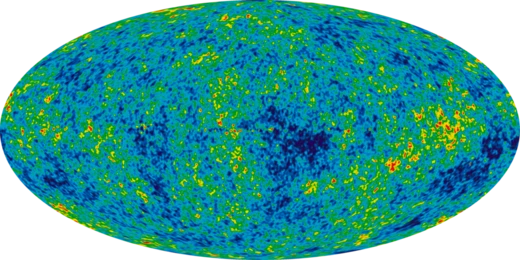
Reionization
Reionization transformed neutral hydrogen into ionized plasma after the Dark Ages.

Reionization is the process that caused electrically neutral atoms in the primordial universe to reionize after the lapse of the 'dark ages'. This phase change was driven by the formation of the first stars and galaxies, which emitted energetic photons that ionized the surrounding neutral hydrogen gas. Detecting and studying reionization is challenging but multiple avenues have been pursued, including observations of quasars, the cosmic microwave background, and Lyman alpha emission.
- field
- Big Bang theory and cosmology
- known_for
- The process that reionized neutral hydrogen in the primordial universe, ending the Dark Ages
- key_observational_tools
- Quasars, CMB anisotropy and polarization, Lyman alpha emission
Lore & Background
Reionization refers to a change in the intergalactic medium from neutral hydrogen to ions. Neutral hydrogen had been ions at an earlier stage in the universe's history, thus the conversion back into ions is termed reionization. The process was driven by energetic photons emitted by the first stars and galaxies. In the timeline of the universe, neutral hydrogen gas originally formed when primordial hydrogen nuclei (protons) combined with electrons. Light with sufficient energy will ionize neutral hydrogen gas. At early times, light was so dense and energetic that hydrogen atoms would be immediately re-ionized. As the universe expanded and cooled, the rate of recombination of electrons and protons to form neutral hydrogen was higher than the ionization rate. The second phase change occurred once objects started to form in the early universe emitting radiation energetic enough to re-ionize neutral hydrogen. As these objects formed and radiated energy, the universe reverted from being composed of neutral atoms to once again being an ionized plasma. At that time, matter had been diffused by the expansion of the universe, and the scattering interactions of photons and electrons were much less frequent than before electron-proton recombination. Thus, the universe was full of low density ionized hydrogen and remained transparent, as is the case today. It is believed that primordial helium also experienced a similar reionization phase change, but at a later epoch. Theoretical models give a timeline of the reionization process. In the first stage, each new star is surrounded by neutral hydrogen. Light emitted by the star ionizes gas immediately around the star, then can reach further out to ionize gas. Ions can recombine, competing with the ionization process. The ionized gas will be hot and expand, clearing out the region around the star. The sphere of ionized gas expands until the amount of light from the star that can cause ionizations balances the recombination, a process that takes hundreds of millions of years. At some point the shells of ionization from each star in a galaxy begin to overlap and the ionization frontier pushes out into the intergalactic medium.
Reader's Guide
Reionization is a pivotal epoch in cosmic history, marking the transition from the neutral hydrogen of the Dark Ages to the ionized plasma that characterizes the universe today. Its study provides critical insights into the formation of the first stars and galaxies, which drove the reionization process. Observational methods include analyzing quasar spectra for the Gunn-Peterson trough, which indicates neutral hydrogen along the line of sight. Quasars above redshift z = 6 show such a trough, suggesting the intergalactic medium was still partly neutral, while those below do not, implying the hydrogen was ionized. This suggests the universe was approaching the end of reionization at z = 6, though long absorption troughs down to z < 5.5 indicate reionization may have extended later. The cosmic microwave background (CMB) provides another avenue: Thomson scattering off free electrons during reionization introduces secondary anisotropies and polarization. The Wilkinson Microwave Anisotropy Probe (WMAP) initially suggested reionization from 30 > z > 11, but later three-year data gave z = 11 to z = 7, in better agreement with quasar data. The optical depth to reionization (τ) and the redshift of reionization (zre) are key parameters, though reionization was likely not instantaneous. Lyman alpha emission from galaxies offers a complementary tool. Understanding reionization helps constrain the timing and nature of early structure formation.
Did You Know?
- The Gunn-Peterson trough in quasar spectra indicates the presence of neutral hydrogen along the line of sight, and quasars above z = 6 show this trough.
- The Wilkinson Microwave Anisotropy Probe (WMAP) three-year data suggested reionization began at z = 11 and the universe was ionized by z = 7.
More in Cosmology Concepts 25-39
Elsewhere in the Cosmology Concepts universe
Spotted an error? Know more?
This is a living reference — every entry is fact-audited, and reader corrections feed straight into our audit queue. Suggest an edit · See this site's audit record