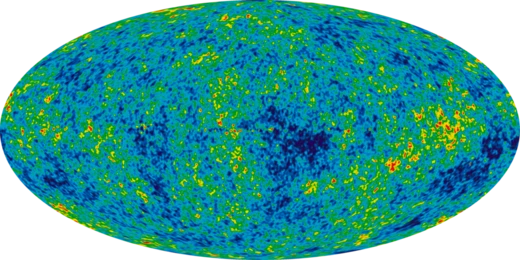
Expansion of the universe
The increase in distance between gravitationally unbound parts of the universe.

The expansion of the universe is the increase in distance between gravitationally unbound parts of the observable universe with time. It is an intrinsic expansion, meaning the universe does not expand into anything or require space outside it. Discovered through separate theoretical and observational work in the 1920s, cosmic expansion has become a core aspect of cosmology and a key feature of Big Bang cosmology, modeled mathematically with the Friedmann–Lemaître–Robertson–Walker metric within general relativity.
- discovery_period
- 1920s
- key_contributors
- Vesto Slipher, Alexander Friedmann, Knut Lundmark, Georges Lemaître, Edwin Hubble
- field
- Cosmology
- defining_law
- Hubble's law (Hubble–Lemaître law)
- current_model
- Lambda-CDM model
Reader's Guide
The expansion of the universe is a foundational concept in modern cosmology, providing the observational and theoretical framework for the Big Bang model. Its discovery in the 1920s through the work of Slipher, Friedmann, Lundmark, Lemaître, and Hubble transformed humanity's understanding of the cosmos from a static to a dynamic entity. The expansion is quantified by the scale factor and the Hubble parameter, with the present-day Hubble constant remaining a subject of precise measurement. The Lambda-CDM model, the current standard model, incorporates different expansion rates over time, including an early inflationary epoch and a recent acceleration driven by dark energy. This concept has driven major scientific projects, such as the Hubble Space Telescope and WMAP satellite, to characterize expansion and its effects. The expansion does not imply motion through space but rather the intrinsic stretching of space itself, and it does not violate the speed limit of light in local reference frames. Understanding cosmic expansion is essential for studying the universe's origin, evolution, and ultimate fate.
Did You Know?
- The expansion of the universe was discovered through separate theoretical and observational work in the 1920s.
- The very earliest expansion, called inflation, saw the universe suddenly expand by a factor of at least 10²⁶ in every direction about 10⁻³² of a second after the Big Bang.
More in Cosmology Concepts 1-24
Elsewhere in the Cosmology Concepts universe
Spotted an error? Know more?
This is a living reference — every entry is fact-audited, and reader corrections feed straight into our audit queue. Suggest an edit · See this site's audit record