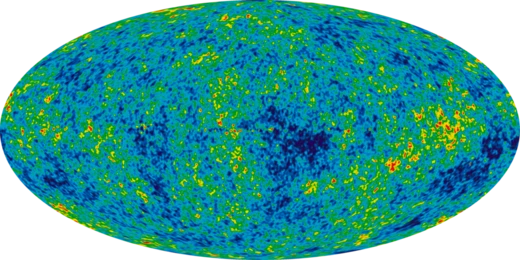
Discovery of cosmic microwave background radiation

The discovery of cosmic microwave background (CMB) radiation is a landmark event in modern physical cosmology. They estimated its temperature as 3.5 K, and the radiation was later interpreted as evidence for the Big Bang theory, providing a crucial refutation of the steady state theory.
- field
- Physical cosmology, radio astronomy
- known_for
- Discovery of cosmic microwave background radiation
- nationality
- American
- estimated_temperature
- 3.5 K
- instrument
- Holmdel Horn Antenna
Lore & Background
After removing pigeons nesting in the antenna and cleaning out droppings, the noise remained, leading them to conclude it came from outside our galaxy. At the same time, astrophysicists Robert H. Dicke, Jim Peebles, and David Wilkinson at Princeton University were preparing to search for microwave radiation from the Big Bang. Penzias learned of Peebles' preprint paper through Bernard F. Burke and contacted Dicke, who sent a copy of the paper. Dicke, Peebles, Wilkinson, and P. G. Roll interpreted the radiation as a signature of the Big Bang. To avoid conflict, they published jointly: Dicke's group outlined the CMB's importance, while Penzias and Wilson reported a 3.5 K residual background noise, attributing a possible explanation to Dicke's companion letter.
Reader's Guide
The discovery of the cosmic microwave background radiation fundamentally shifted cosmology from a speculative field to an empirical science. By providing direct evidence for a hot early universe, it confirmed the Big Bang theory and discredited the steady state theory, which had no mechanism to produce such a uniform background. The CMB remains a cornerstone of modern cosmology, used to study the universe's age, composition, and evolution.
Did You Know?
- Penzias and Wilson initially thought the persistent noise might be due to pigeon droppings in their antenna.
- The CMB temperature they measured was 3.5 K, after accounting for a 2.3 K sky absorption component and a 0.9 K instrumental component.
More in Cosmology Concepts 1-24
Elsewhere in the Cosmology Concepts universe
Spotted an error? Know more?
This is a living reference — every entry is fact-audited, and reader corrections feed straight into our audit queue. Suggest an edit · See this site's audit record