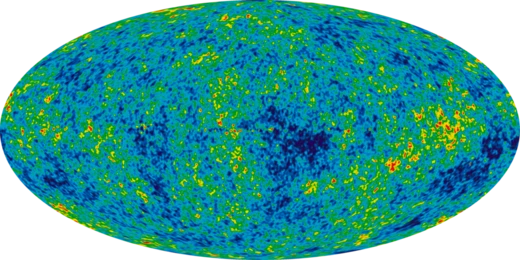
Universe
The totality of all space, time, matter, and energy.

The universe comprises all of existence: all forms of matter and energy, and the structures they form, from subatomic particles to entire galactic filaments. Since the early 20th century, the field of cosmology has established that the universe has been expanding for 13.8 billion years, starting from a dense fireball in an event called the Big Bang.
- Age
- 13.8 billion years
- Diameter (observable)
- 93 billion light-years
- Composition (ordinary matter)
- 4.84% ± 0.1%
- Composition (dark matter)
- 25.8% ± 1.1%
- Composition (dark energy)
- 69.2% ± 1.2%
- Shape at largest scale
- Isotropic and homogeneous
- Structure
- Foam-like, with filaments and voids
Lore & Background
The universe contains all energy and matter, including planets, moons, stars, galaxies, and intergalactic space. Some philosophers and scientists support the inclusion of ideas and abstract concepts—such as mathematics and logic—in its definition. The word 'universe' derives from the Latin 'universus', meaning 'combined into one', and was used by Cicero and later Latin authors in senses similar to the modern English word. The prevailing model for the evolution of the universe is the Big Bang theory, based on general relativity and symmetry assumptions such as homogeneity and isotropy. The earliest state was extremely hot and dense, cooling during expansion. An intense period called cosmic inflation is postulated to explain many observations. Within the first fraction of a second, the universe was extremely dense, with all Standard Model particles in equilibrium. As it cooled, phase transitions occurred, producing a plasma of electrons, protons, and neutrons. About one minute after the Big Bang, nucleosynthesis began, lasting about 15 minutes and producing helium, deuterium, and traces of lithium. At the largest scale, galaxies are distributed uniformly and the same in all directions. At smaller scales, galaxies form clusters and superclusters, creating immense filaments and voids—a vast foam-like structure. The universe contains much more matter than visible objects account for; this unseen matter is called dark matter. Dark energy, a mysterious form of energy, is responsible for the acceleration of the universe's expansion. There are many competing hypotheses about the ultimate fate of the universe and about what, if anything, preceded the Big Bang.
Reader's Guide
The universe is the central subject of cosmology, the scientific study of its origin, evolution, and large-scale structure. Its definition as 'the totality of all space and time; all that is, has been, and will be' underpins all physical science. The discovery that the universe is expanding, isotropic, and homogeneous at the largest scales revolutionized human understanding, replacing earlier geocentric and heliocentric models. The Big Bang theory, supported by evidence such as the cosmic microwave background and nucleosynthesis, provides the prevailing model for its evolution. The identification of dark matter and dark energy—together constituting about 95% of the universe's mass-energy—has opened profound questions about fundamental physics. The observable universe's diameter of 93 billion light-years and the unknown total size highlight both the vastness and the limits of human knowledge. The universe's foam-like structure of filaments and voids reveals the imprint of initial density fluctuations. Its significance lies in being the ultimate context for all existence, and its study continues to challenge and expand the frontiers of science.
Did You Know?
- The observable universe is approximately 93 billion light-years in diameter, but the total size of the universe is not known.
- Ordinary baryonic matter composes only 4.84% ± 0.1% of the universe; dark matter accounts for about 25.8% and dark energy for about 69.2%.
- The word 'universe' derives from the Latin 'universus', meaning 'combined into one', and was used by Cicero.
More in Cosmology Concepts 25-39
Elsewhere in the Cosmology Concepts universe
Spotted an error? Know more?
This is a living reference — every entry is fact-audited, and reader corrections feed straight into our audit queue. Suggest an edit · See this site's audit record