Recombination (cosmology)
Epoch when electrons and protons first formed neutral hydrogen atoms.
Recombination is the cosmological epoch when free electrons and protons first bonded into electrically neutral hydrogen atoms. The name is a historical misnomer: the Big Bang theory does not claim that protons and electrons had previously been combined, but the term was coined before the Big Bang became the leading explanation for the universe's origin.
Just before recombination, the universe contained almost no neutral hydrogen. Although atoms could theoretically form, any newly created neutral hydrogen was instantly ionized by the abundant high-energy photons. As the universe expanded and cooled, the radiation field eventually lost enough energy to ionize neutral hydrogen, making atoms energetically stable.
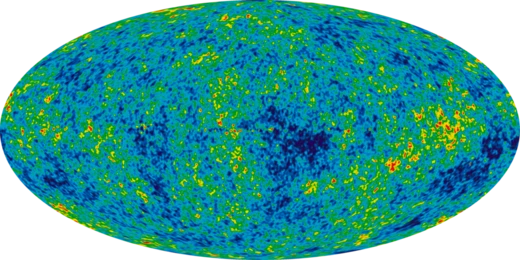
Photon decoupling—when photons began traveling freely through space without interacting with matter—occurred around the same time as recombination, but the two are distinct events driven by different physical processes. Recombination happened when expansion lowered the temperature, allowing atoms to form and releasing some photons. Photon decoupling happened when expansion diluted the electron density, enabling the far more numerous photons to propagate without scattering; this produced the cosmic microwave background radiation.
The timing of recombination can be estimated from the cosmic microwave background's temperature evolution. The CMB is a blackbody spectrum, shifted in energy by cosmic expansion (redshift, denoted z). Today's CMB temperature is about 2.7 K. Simply comparing the blackbody peak thermal energy (Boltzmann constant times temperature) to hydrogen's ionization energy (13.6 eV) is insufficient, because the photon energy distribution matters. A better estimate considers thermal equilibrium between matter and radiation. The density of photons with enough energy to ionize hydrogen equals the total photon density multiplied by a Boltzmann factor. At equilibrium, this roughly equals the baryon density. The baryon-to-photon ratio, known from Planck satellite measurements and other sources, is about 10⁻⁹. Solving for the redshift gives a value near 1100, corresponding to roughly 400,000 years after the Big Bang.
The cosmic ionization history is described by the free electron fraction, xₑ, as a function of redshift. This is the ratio of free electron density to total hydrogen density (neutral plus ionized). Since hydrogen recombines only after helium is fully neutral, charge neutrality implies that the free electron density equals the proton density, so xₑ also represents the fraction of ionized hydrogen.
A rough estimate of the recombination redshift comes from assuming the reaction H⁺ + e⁻ ⇌ H + γ proceeds near thermal equilibrium. The Saha equation then gives the relative abundances of free electrons, protons, and neutral hydrogen. With charge neutrality, the equation becomes an expression for xₑ. All quantities on the right side are known functions of redshift: temperature scales as T = 2.7 K × (1 + z), and the total hydrogen density is given by n_H = (1 + z)³ × (baryon density today). Solving for 50% ionization yields a recombination temperature of roughly 3000 K, corresponding to z ≈ 1100.
In 1968, Jim Peebles in the US and Yakov Borisovich Zel'dovich and collaborators in the USSR independently calculated hydrogen's non-equilibrium recombination history. Their model's key points are: Direct recombinations to the ground state are inefficient because each such event produces a photon above 13.6 eV, which almost immediately re-ionizes a neighboring hydrogen atom. Instead, electrons efficiently recombine to excited states, then quickly cascade to the first excited state (n = 2). From there, two pathways lead to the ground state (n = 1): decay from the 2p state via a Lyman-α photon, which is usually reabsorbed but may escape if cosmological redshift moves it far enough from the Lyman-α resonance before encountering another hydrogen atom; and decay from the 2s state via two-photon emission, a slow process (rate 8.22 s⁻¹) that nevertheless competes with the slow Lyman-α escape. Atoms in the first excited state can also be re-ionized by ambient CMB photons before reaching the ground state, effectively undoing the recombination. To account for this, Peebles defined a factor C as the probability that an atom in the first excited state reaches the ground state.
- epoch
- Recombination
- field
- Cosmology
- key_process
- Formation of neutral hydrogen atoms from free electrons and protons
- related_event
- Photon decoupling (same time frame, distinct physical process)
Lore & Background
Recombination is the epoch when free electrons and protons first combined to form neutral hydrogen atoms. Despite its name, the “re-” prefix is historically misleading, as the Big Bang theory does not propose that these particles had previously been bound. The event occurred when the universe had cooled sufficiently that the ambient radiation field could no longer immediately ionize newly formed atoms. Recombination is distinct from photon decoupling, though both happened around the same time: recombination produced atoms and some photons, while decoupling—caused by the expansion diluting electrons—allowed photons to travel freely, creating the cosmic microwave background (CMB). The recombination time frame is estimated from the CMB’s blackbody spectrum, whose temperature is redshifted by cosmic expansion. A rough equilibrium calculation uses the Saha equation, which balances the densities of free electrons, protons, and neutral hydrogen. The ratio of baryons to photons, measured by the Planck satellite at about 10⁻⁹, yields a redshift near 1100, corresponding to roughly 400,000 years after the Big Bang. The free electron fraction, defined as the ratio of free electrons to total hydrogen, describes the ionization history. In 1968, Jim Peebles and, independently, Yakov Zel’dovich and collaborators developed a non-equilibrium model. Direct recombinations to hydrogen’s ground state are inefficient because they produce high-energy photons that quickly re-ionize neighboring atoms. Instead, electrons recombine to excited states, cascading to the first excited level. From there, atoms reach the ground state via two slow pathways: decay from the 2p state emitting a Lyman-α photon, which may escape reabsorption if redshifted away from resonance, or two-photon decay from the 2s state. Ambient CMB photons can also re-ionize atoms in the first excited state before they reach the ground state, a probability accounted for by the Peebles factor C.
Reader's Guide
Recombination marks a critical transition in the early universe, when the plasma of free electrons and protons cooled enough to form neutral hydrogen atoms. This epoch is fundamental to cosmology because it directly led to the decoupling of photons, producing the cosmic microwave background radiation that provides a snapshot of the universe at that time. The Saha equation gives a rough estimate of the recombination redshift by assuming thermal equilibrium between matter and radiation. The free electron fraction, defined as the ratio of free electrons to total hydrogen, describes the cosmic ionization history. Recombination is distinct from photon decoupling, though they occur in the same time frame. Understanding recombination is essential for interpreting the CMB and for models of structure formation, as the neutral hydrogen allowed matter to clump gravitationally without being disrupted by radiation pressure.
Did You Know?
- The 're-' in 'recombination' is misleading because the Big Bang theory does not posit that protons and electrons had been combined before.
- Photon decoupling, which produced the cosmic microwave background, occurred in the same time frame as recombination but is a distinct physical process.
- The ratio of baryons to photons, known from Planck satellite measurements, is around 10⁻⁹.
Frequently Asked Questions
What is Recombination in cosmology?
Recombination is the epoch when free electrons and protons first bound together to form electrically neutral hydrogen atoms. It marks the universe's shift from an opaque plasma to a state where light could finally travel freely.
What is Recombination's role in the cosmic timeline?
Recombination acts as the critical turning point where the universe became transparent to radiation. It occurs in the same time frame as photon decoupling, though the two are distinct physical processes.
Why is it called 'recombination' if nothing was combined before?
The name is a historical artifact that predates the Big Bang model becoming the dominant theory of cosmic origins. The term simply stuck in the literature even after the framework made clear that protons and electrons had never been bound prior to this event.
Why is Recombination important to cosmology?
Without Recombination, the universe would have remained a light-scattering plasma, and neither the cosmic microwave background nor the large-scale structure we observe today could exist. It effectively set the stage for stars, galaxies, and all later cosmic evolution.
How does Recombination's 'story' resolve?
The epoch concludes with photons decoupling from matter, leaving the universe transparent and allowing light to stream unimpeded across space. That ancient glow, redshifted over billions of years, is what we detect today as the cosmic microwave background.
More in Cosmology Concepts 1-24
Spotted an error? Know more?
This is a living reference — every entry is fact-audited, and reader corrections feed straight into our audit queue. Suggest an edit · See this site's audit record