Quark epoch
Early universe period when quarks existed freely in a plasma.
The quark epoch was a period in the evolution of the early universe, following the electroweak epoch and preceding the hadron epoch. It began approximately 10⁻¹² seconds after the Big Bang, at the moment when the electroweak interaction split into the separate forces of electromagnetism and the weak interaction. By this time, all four fundamental interactions—gravitation, electromagnetism, the strong force, and the weak force—had assumed their modern forms. However, the universe remained extremely hot and dense, filled with a quark–gluon plasma. This plasma consisted of free quarks, leptons, and their corresponding antiparticles, all in a highly energetic state. Particle collisions during this era were so violent that quarks could not bind together to form composite particles such as mesons or baryons (collectively known as hadrons). The universe’s temperature was simply too high for the strong force to confine quarks within these larger structures. This state persisted until the universe was roughly 10⁻⁶ seconds old. At that point, the average energy of particle interactions dropped below the binding energy required to hold hadrons together. Consequently, quarks became confined within hadrons, marking the end of the quark epoch and the beginning of the hadron epoch. The quark epoch thus represents a critical transitional phase in cosmic history, bridging the era of unified electroweak forces and the later era of composite matter.
- began
- approximately 10⁻¹² seconds after the Big Bang
- ended
- approximately 10⁻⁶ seconds after the Big Bang
- preceded_by
- electroweak epoch
- followed_by
- hadron epoch
- key_feature
- quark–gluon plasma
- temperature
- too high for hadron formation
Lore & Background
The quark epoch began roughly one ten-trillionth of a second after the Big Bang, immediately following the electroweak epoch. At that moment, the electroweak interaction split into the weak nuclear force and electromagnetism, leaving all four fundamental forces—gravity, electromagnetism, the strong force, and the weak force—in their modern forms. However, the universe remained so hot and dense that quarks and gluons existed freely as a plasma, unable to bind into composite particles. This quark–gluon plasma also contained leptons and their antiparticles, all colliding with such high energy that no mesons or baryons could form. The epoch persisted until the universe was about one millionth of a second old. At that point, the average energy of particle interactions dropped below the binding energy required to hold hadrons together. This cooling allowed quarks to become confined within hadrons, marking the end of the quark epoch and the beginning of the hadron epoch. During this brief period, the universe was a seething, opaque soup of fundamental particles, with no stable matter as we know it today.
Reader's Guide
The quark epoch is significant in physical cosmology as a distinct phase in the early universe's thermal history, marking the period when the strong interaction and other fundamental forces had assumed their current forms but the ambient energy prevented quark confinement. This epoch bridges the electroweak epoch and the hadron epoch, illustrating the progression from a unified electroweak force to a universe where matter could form composite particles. Understanding the quark epoch helps cosmologists model the conditions of the early universe and the sequence of symmetry breaking and phase transitions that led to the present-day cosmos. Its study relies on particle physics and the behavior of quark–gluon plasma, which is also investigated in high-energy collider experiments.
Did You Know?
- The quark epoch began approximately 10⁻¹² seconds after the Big Bang.
- During the quark epoch, the universe was filled with a dense, hot quark–gluon plasma.
- The quark epoch ended when the universe was about 10⁻⁶ seconds old.
- The following period, when quarks became confined within hadrons, is known as the hadron epoch.
The Inflationary Genesis
The earliest chapter of cosmic history, as far as observational evidence can reach, is a phase called inflation. Roughly 13.8 billion years ago, space itself underwent an extraordinary burst of exponential growth, stretching by at least a factor of 10 to the 26th power in a span on the order of 10 to the minus 36 seconds. To grasp the scale, every bit of mass-energy now scattered across all observable galaxies was once packed into a sphere barely 4×10⁻²⁹ meters across, and by the end of this brief epoch it had ballooned to roughly 0.9 meters in radius. When inflation finally ceased, the energy that had powered it was not simply lost; it transformed into a seething bath of particles and radiation, plunging the newborn universe into a state of extreme heat and density. This reheating event marks the conventional starting point of the hot Big Bang. Crucially, inflation also seeded the universe's large-scale architecture: minute quantum ripples, magnified to cosmic proportions during the rapid expansion, are believed to be the origin of the galaxies and clusters we observe today.
The Great Annihilation and Cooling
In the hot, dense aftermath of reheating, the universe was a churning soup of elementary particles. A process called baryogenesis created a slight surplus of matter over antimatter, but the vast majority of particle-antiparticle pairs quickly found each other and annihilated, releasing enormous amounts of radiation. As temperatures continued to drop, heavier exotic particles either decayed or met their antimatter counterparts, thinning the cosmic plasma until only protons, neutrons, electrons, photons, and neutrinos remained as the dominant constituents. After the first second had elapsed, the plasma had grown dilute enough that neutrinos stopped interacting efficiently with everything else; they simply streamed free through space, leaving behind what we now call the primordial neutrino background. Just five seconds later, electrons and their positron partners annihilated en masse, dumping their energy back into the remaining plasma and giving it an additional thermal boost before the next major phase of cosmic evolution could begin.
Nucleosynthesis and the First Transparent Light
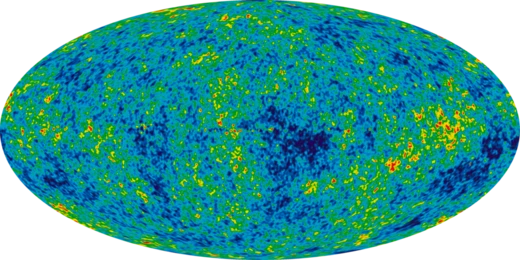
Within roughly three minutes of the Big Bang, temperatures had fallen enough for protons and neutrons to bind into stable atomic nuclei in a process called Big Bang nucleosynthesis. The products were modest by today's standards: hydrogen, helium, and trace quantities of lithium. Most cosmological models also assume that dark matter was produced during this epoch, though the precise mechanism remains unknown. The universe then continued its long cooling journey. Around 380,000 years after the initial hot dense state, temperatures dropped sufficiently for free electrons to be captured by the newly formed nucleons, creating the first stable atoms. This event had a profound consequence: with electrons no longer scattering photons freely, the universe became transparent to electromagnetic radiation for the first time. The light released at that moment has been traveling ever since, its wavelength stretched by the ongoing expansion of space until it arrives at our telescopes as the cosmic microwave background—a faint, nearly uniform glow that serves as one of the strongest pieces of evidence for the hot Big Bang model.
From Atomic Gas to Accelerated Expansion
Once the universe became transparent, the story shifted from particle physics to gravity. The atomic gas that filled space began to clump under its own gravitational pull. As pockets of gas compressed and heated, they eventually reached conditions hot enough to ignite nuclear fusion, birthing the first stars. Over the following millions of years, gravitational attraction continued to weave matter into larger and larger structures—galaxies, clusters, and the vast cosmic web we see today. For billions of years, matter dominated the cosmic energy budget, and gravity was the principal sculptor of structure. Then, after roughly nine billion more years of expansion, the balance tipped: dark energy, whose nature remains mysterious, began to overwhelm the gravitational pull of matter. The result is the accelerated expansion of the universe that modern observations confirm. Because the earliest phases before nucleosynthesis lack direct observational evidence, many researchers have proposed modifications to the standard timeline, introducing novel expansion phases, exotic particles, or alternative mechanisms to inflation that still reproduce the large-scale structure we observe.
Frequently Asked Questions
Who is Quark epoch?
The Quark epoch is a brief stage in the early universe's history, sitting between the electroweak epoch and the hadron epoch. During this window the cosmos was a searing soup of free-floating quarks and gluons because temperatures were far too high for them to clump into composite particles.
What are Quark epoch's powers/role?
Its defining trait is the existence of a quark–gluon plasma, a state of matter in which quarks roam freely rather than being locked inside protons or neutrons. It also marks the first period where all four fundamental forces had settled into their modern configurations.
How does Quark epoch's story end?
The epoch closes around one-millionth of a second after the Big Bang, when the universe cooled enough for quarks to finally bind into hadrons. That cooling transition hands the narrative directly to the hadron epoch.
Why is Quark epoch important?
It is the first era in which the strong, electromagnetic, weak, and gravitational interactions all operated in their present-day forms. Without this cooling window, quarks would never have had the chance to form the hadrons that eventually built nuclei and atoms.
When does Quark epoch appear in the timeline?
It kicks in roughly 10⁻¹² seconds after the Big Bang, immediately after the electroweak epoch wraps up. It lasts until about 10⁻⁶ seconds, giving it a total span of roughly half a millionth of a second.
More in Cosmology Concepts 1-24
Spotted an error? Know more?
This is a living reference — every entry is fact-audited, and reader corrections feed straight into our audit queue. Suggest an edit · See this site's audit record