Primordial fluctuations
Density variations seeding all cosmic structure.
Primordial fluctuations are tiny variations in density that existed in the early universe, and they are thought to be the origin of every structure we see today. The leading theory for how they formed comes from cosmic inflation: during a period of rapid expansion, quantum fluctuations in the inflaton field were stretched to enormous sizes. Once these fluctuations expanded beyond the observable horizon, they effectively became frozen in place.
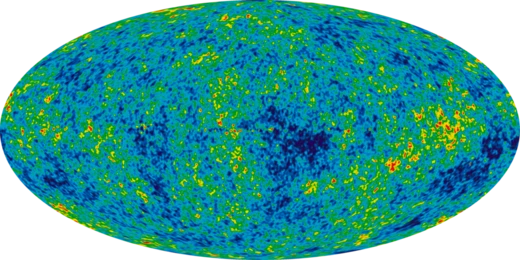
Later, during the eras dominated by radiation and then matter, these fluctuations re-entered the horizon. This re-entry set the initial conditions for the formation of galaxies and other cosmic structures. Scientists can study the statistical properties of these fluctuations by looking at the cosmic microwave background's anisotropies and by mapping the distribution of matter, such as through galaxy redshift surveys. Because inflation is thought to be the source of these fluctuations, such measurements also place limits on the parameters of inflationary models.
The fluctuations are usually described using a power spectrum, which shows how much variation exists at different spatial scales. This is often expressed in terms of the fractional energy density fluctuation, defined as δ(x) = (ρ(x) − ρ̄) / ρ̄, where ρ is the energy density and ρ̄ is its average. The power spectrum P(k) is then defined through the ensemble average of the Fourier components: ⟨δ̃(k)δ̃(k′)⟩ = (2π)³ δ(k − k′) P(k), where δ is the Dirac delta function and angle brackets denote an average over many possible universes.
There are two main types of fluctuations: scalar and tensor. Scalar fluctuations are described by a power spectrum that gives the mean squared density fluctuation for a given wavenumber k. Many inflationary models predict that this scalar component follows a power law. The scalar spectral index, n_s, describes how the fluctuations change with scale. A value of n_s = 1 corresponds to scale-invariant fluctuations (though this invariance is in the comoving curvature perturbation, not directly in the density). The exact value of n_s depends on the shape of the inflaton's potential, specifically the slow-roll parameters like its gradient and curvature. Models with large positive curvature predict n_s > 1, while simple monomial potentials predict a red spectral index with n_s < 1. Data from Planck gives a specific value for n_s.
Tensor fluctuations, or primordial gravitational waves, are also predicted by many inflationary models. Like scalar fluctuations, they are expected to follow a power law, parameterized by a tensor index. The ratio of the tensor power spectrum to the scalar power spectrum is given by r = P_t / P_s, where the factor of 2 accounts for the two polarization states of tensor modes. Data from the Planck satellite in 2015 placed a constraint on this ratio.
Fluctuations can also be classified as adiabatic or isocurvature. Adiabatic fluctuations have equal fractional overdensities in the number density of all types of matter and energy—for example, a photon overdensity of a factor of two would be matched by an electron overdensity of the same factor. In isocurvature fluctuations, the number density variations in one component do not necessarily match those in another. While the initial fluctuations are usually assumed to be adiabatic, the possibility of isocurvature modes is considered in light of current data. Observations of the cosmic microwave background strongly favor adiabatic fluctuations and place tight limits on uncorrelated isocurvature cold dark matter modes.
- field
- Cosmology
- known_for
- Seeds of all cosmic structure; quantified by power spectrum; scalar and tensor modes
Lore & Background
Primordial fluctuations are density variations in the early universe that serve as the seeds for all cosmic structure. They are believed to originate from quantum fluctuations of the inflaton field during cosmic inflation, when the rapid exponential expansion stretched these microscopic variations to macroscopic scales. As these fluctuations exited the observable horizon, they "froze in," later re-entering during the radiation- and matter-dominated eras to set the initial conditions for structure formation. Their statistical properties are inferred from observations of cosmic microwave background anisotropies and galaxy redshift surveys. These fluctuations are quantified by a power spectrum that describes the power of variations across spatial scales. The fractional energy density is defined as δ(x→) = ρ(x→)/ρ̄ − 1, with the power spectrum P(k) given by the ensemble average of Fourier components. Fluctuations come in scalar and tensor modes. Scalar modes represent density variations and are often modeled as a power law, with the scalar spectral index describing how these variations change with scale; different inflationary potentials predict different spectral indices based on slow-roll parameters. Tensor modes, predicted by many inflationary models, also follow a power law and are parameterized by a tensor index. The ratio of tensor to scalar power spectra accounts for the two polarizations of tensor modes. Fluctuations can be adiabatic, where all matter and energy components share equal fractional overdensities, or isocurvature, where number density variations differ between components. Current cosmic microwave background data favor adiabatic fluctuations and constrain isocurvature modes to be small.
Reader's Guide
Primordial fluctuations are fundamental to modern cosmology as they set the initial conditions for structure formation. Their statistical properties can be inferred from observations of anisotropies in the cosmic microwave background and from measurements of the distribution of matter, such as galaxy redshift surveys. Because the fluctuations are believed to arise from inflation, such measurements also constrain parameters within inflationary theory. Many inflationary models predict a power law for the scalar component, with n_s = 1 corresponding to scale-invariant fluctuations in the comoving curvature perturbation. Tensor fluctuations are also predicted by many inflationary models and are parameterized by the tensor index and the tensor-to-scalar ratio r.
Did You Know?
- Primordial fluctuations are density variations in the early universe considered the seeds of all structure.
- The most widely accepted explanation for their origin is in the context of cosmic inflation.
- There are both scalar and tensor modes of fluctuations.
From Supercooling to Stars: The Primordial Unfolding
The story of our cosmos begins not with a bang in the colloquial sense, but with a phase of extraordinarily rapid accelerated expansion known as cosmic inflation. During this earliest epoch, the universe was driven to a supercooled state before a dramatic reheating event converted the energy fueling inflation into a searing, dense plasma—the true hot Big Bang. As that plasma expanded and cooled over time, the conditions gradually permitted the assembly of subatomic particles and, eventually, the first atoms. The primordial chemical inventory was remarkably simple: overwhelmingly hydrogen, accompanied by modest quantities of helium and a trace of lithium. Under the pull of gravity, and with the gravitational scaffolding provided by dark matter, these early elements gathered into the first stars and galaxies. Detailed measurements of the universe's expansion rate pin the onset of inflation to approximately 13.787 billion years ago, with a margin of uncertainty of just two hundred million years. This figure is now regarded as the age of the universe itself, anchoring every subsequent chapter of cosmic evolution to a single, precise starting point.
A Century of Convergence: How the Expanding Universe Was Proven
The idea that space itself is stretching did not arrive all at once. In 1922, Alexander Friedmann produced the mathematical framework—the Friedmann equations—that first described a universe in expansion. Seven years later, Edwin Hubble delivered the observational punch: galaxies were receding from Earth, and their recession speed grew in direct proportion to their distance. Remarkably, in 1931, Georges Lemaître arrived at a parallel vision entirely on his own, proposing that the cosmos had burst forth from a primeval atom, a formulation that closely mirrors the modern Big Bang narrative. The decisive empirical confirmation came by accident in 1964, when the cosmic microwave background was first detected. Subsequent measurements over the following years revealed that this radiation was nearly uniform across the sky and that its spectral shape matched the predictions of a hot, dense early universe. By the late 1960s, the competing steady-state picture had effectively lost the support of the cosmological community.
The Scaffolding: Assumptions and the Density Budget
Every Big Bang model rests on three foundational pillars. First, the laws of physics are assumed to hold universally throughout space and time—a principle already embedded in relativity. Second, the cosmological principle declares that on sufficiently large scales the universe looks the same in every direction from every location, meaning it is both homogeneous and isotropic. Third, the cosmic contents are treated as a perfect fluid with no viscosity and pressure proportional to density. These were once mere postulates, but they have since been tested. Observations constrain any drift in the fine-structure constant to roughly ten to the minus fifth over cosmic history, and general relativity has withstood rigorous checks in the Solar System and around binary stars. CMB temperature measurements confirm the cosmological principle to a precision of about ten to the minus fifth. The payoff of these assumptions is elegant: the geometry and expansion of the universe reduce to a single controlling parameter, the mass-energy density. In today's cosmos, that budget breaks down into less than five percent luminous matter, twenty-seven percent dark matter, and sixty-eight percent dark energy.
The Edges of Knowing: Horizons and Open Mysteries
Despite the model's broad success, several deep puzzles remain stubbornly unsolved. The observed surplus of matter over antimatter—the baryon asymmetry—has no fully satisfactory explanation within standard Big Bang cosmology. The detailed physical nature of the dark matter that halos galaxies, and the origin of the dark energy now driving accelerated expansion, are likewise unresolved. Beyond these compositional mysteries, the very structure of spacetime imposes observational limits. Because the universe has a finite age and light travels at a finite speed, there exists a past particle horizon: events so distant that their photons have not yet reached us. Conversely, the ongoing expansion of space means that light we emit today may never catch up to sufficiently remote objects, defining a future horizon that caps the region of the universe we can ever influence. Whether a given horizon exists at all depends on the specific parameters of the Friedmann–Lemaître–Robertson–Walker metric. In practice, our backward view is further muddied by the opacity of the early universe, which scatters and absorbs the very light we would need to see deeper into the primordial past.
Frequently Asked Questions
What are primordial fluctuations?
They are minute density irregularities present in the very early universe that eventually grew under gravity into every galaxy, cluster, and filament we see today. In short, they are the original seeds from which all cosmic structure emerged.
Where do primordial fluctuations come from?
The standard inflationary picture holds that quantum jitters in the inflaton field were blown up to astronomical sizes as space expanded exponentially. Once a given fluctuation's wavelength crossed the Hubble horizon, it could no longer smooth itself out and effectively 'froze in' as a classical perturbation.
How are primordial fluctuations quantified?
Cosmologists describe them with a power spectrum that tells you the amplitude of perturbations as a function of spatial scale. The spectrum is split into scalar modes (density and velocity perturbations) and tensor modes (stochastic gravitational waves), and both are parameterized by a few key numbers such as the scalar spectral index and the tensor-to-scalar ratio.
Why do primordial fluctuations matter for the universe we observe?
Without those initial clumps of slightly higher density, matter would have kept expanding uniformly and no gravitational collapse would ever have occurred. They are therefore the single most important ingredient linking the nearly uniform early universe to the rich web of galaxies and dark-matter halos we map today.
How do we actually see primordial fluctuations?
The temperature anisotropies in the cosmic microwave background are essentially a frozen snapshot of those density ripples roughly 380,000 years after the Big Bang. On larger scales, the same initial perturbations show up as the statistical clustering of galaxies measured in surveys like SDSS and DESI.
More in Cosmology Concepts 1-24
Spotted an error? Know more?
This is a living reference — every entry is fact-audited, and reader corrections feed straight into our audit queue. Suggest an edit · See this site's audit record