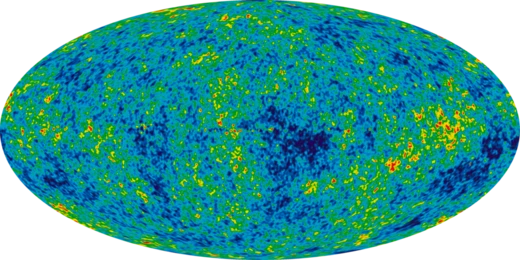
Physical cosmology
Study of the universe's origin, structure, and evolution.
Physical cosmology is a branch of physics that seeks to model the entire universe using the laws of physics, providing a mathematical framework for understanding its largest-scale structures, dynamics, origin, evolution, and ultimate fate. The field’s scientific roots lie in the Copernican principle, which holds that celestial bodies obey the same physical laws as those on Earth, and in Newtonian mechanics, which first allowed those laws to be systematically applied. Modern physical cosmology began in 1915 with Albert Einstein’s general theory of relativity, which describes gravity as a geometric property of space and time. Einstein initially believed in a static universe and introduced a cosmological constant into his field equations to counteract gravitational attraction, publishing the first relativistic cosmological model in 1917. This model, describing a finite but unbounded static universe, was later found to be unstable. In the early 1920s, Alexander Friedmann derived more general solutions to Einstein’s equations, allowing for expanding or contracting universes with open, flat, or closed geometry. Observational breakthroughs followed: in the 1910s, Vesto Slipher interpreted the redshift of spiral nebulae as a Doppler shift indicating recession, though distances were not yet understood. In 1927, Georges Lemaître independently derived the Friedmann equations and proposed that the universe began with an explosion from a “primeval atom,” later called the Big Bang. Edwin Hubble confirmed this in 1929 by measuring distances to spiral nebulae using Cepheid variables, establishing a relationship between a galaxy’s redshift and its distance—now known as Hubble’s law—which implied universal expansion. The Big Bang theory, advocated by George Gamow, became the leading model, though Fred Hoyle’s steady state model offered an alternative. Since the 1990s, dramatic advances in observational cosmology—including studies of the cosmic microwave background, distant supernovae, and galaxy redshift surveys—have produced a standard model requiring large amounts of dark matter and dark energy, whose nature remains poorly understood but whose predictions match diverse observations. Cosmology integrates particle physics, general relativity, quantum mechanics, astrophysics, and plasma physics.
- field
- Physics
- key_figures
- Albert Einstein, Edwin Hubble, Vesto Slipher, Georges Lemaître, Alexander Friedmann
- key_discoveries
- General relativity, expansion of the universe, Big Bang theory, cosmic microwave background
- standard_model
- Big Bang theory with dark matter and dark energy
Lore & Background
Physical cosmology is the branch of physics that creates mathematical models of the universe, describing the structure and behavior of the largest-scale systems and addressing fundamental questions about the universe's origin, evolution, and eventual fate. Its defining characteristic is the application of physical laws—first established by Newtonian mechanics and the Copernican principle, which holds that celestial bodies obey the same laws as those on Earth—to the cosmos as a whole. The modern form of the field began with Albert Einstein's general theory of relativity in 1915, which provided a geometric description of gravity. Early cosmological models, such as Einstein's own static universe, were derived from these equations, though his model was later found to be unstable. In the 1920s, Alexander Friedmann derived general solutions to Einstein's equations that allowed for an expanding or contracting universe. Observational breakthroughs soon followed: Edwin Hubble proved that spiral nebulae were distant galaxies beyond the Milky Way, and Vesto Slipher's work on redshifts indicated that these galaxies were receding from Earth. Hubble then established a relationship between a galaxy's distance and its recessional speed, now known as Hubble's law, which implied the universe is expanding. This led to the Big Bang theory, proposed by Georges Lemaître, which posits the universe began from a "primeval atom." The Big Bang model became the leading explanation, though alternative steady-state models were also proposed. Since the 1990s, dramatic advances in observing the cosmic microwave background, distant supernovae, and galaxy redshifts have produced a standard cosmological model. This model requires large amounts of dark matter and dark energy—whose nature remains poorly understood—but it yields predictions that closely match diverse observations. Cosmology integrates work from particle physics, astrophysics, general relativity, quantum mechanics, and plasma physics.
Reader's Guide
Physical cosmology is significant because it provides the framework for understanding the universe on the largest scales. Dramatic advances since the 1990s, including observations of the cosmic microwave background, distant supernovae, and galaxy redshift surveys, led to a standard model requiring dark matter and dark energy, whose nature is not well understood but whose predictions agree with many observations. Cosmology draws on particle physics, astrophysics, general relativity, quantum mechanics, and plasma physics. The energy of the cosmos includes radiation and matter, with light elements created during Big Bang nucleosynthesis and heavier elements formed in stellar nucleosynthesis. Dark energy is proposed to explain the accelerating expansion of the universe.
Did You Know?
- Edwin Hubble discovered a relationship between a galaxy's redshift and its distance, now called Hubble's law.
- The standard model of cosmology requires large amounts of dark matter and dark energy, whose nature is not well understood.
From Static to Dynamic: The Birth of Relativistic Cosmology
The Copernican principle established that celestial bodies obey the same physical laws as terrestrial objects, and Newtonian mechanics supplied the first framework for understanding those laws. Yet modern physical cosmology truly began in 1915, when Einstein's general relativity recast gravity as a geometric property of space and time. Einstein initially favored a static universe, but his equations revealed that distributed masses would gravitationally attract and draw together over time. To salvage his preferred picture, he added a cosmological constant in 1917, yielding a finite yet unbounded space—reminiscent of a sphere's surface, which has limited area but no edges. That model, however, proved unstable to even the smallest perturbations and would inevitably begin expanding or contracting. Alexander Friedmann then showed in the early 1920s that general relativity actually admitted a whole family of cosmological solutions: universes capable of expansion or contraction, with open, flat, or closed spatial geometry. This realization opened the door to a cosmos in motion and set the stage for every major advance that followed.
The 1920s Revolution: Galaxies, Expansion, and the Big Bang
During the 1910s, Vesto Slipher and Carl Wilhelm Wirtz interpreted the redshifts of spiral nebulae as Doppler shifts signaling recession, but without reliable distance measurements they could not grasp the full cosmological implications. The breakthrough arrived in the late 1920s. In 1927, Belgian priest Georges Lemaître independently derived the expanding-universe equations and proposed that the cosmos originated from the explosion of a primeval atom. Two years later, Edwin Hubble used the brightness of Cepheid variable stars to confirm that spiral nebulae were external galaxies and uncovered a proportional relationship between redshift and distance—now called Hubble's law, though his numerical factor was off by a factor of ten because he had not yet distinguished between Cepheid types. This observational anchor gave Lemaître's Big Bang theory its empirical foundation. For years, support split between the Big Bang and Fred Hoyle's steady-state model, which invoked continuous matter creation. The 1965 detection of the cosmic microwave background, followed by COBE's precise measurements in the early 1990s, ultimately settled the debate in the Big Bang's favor.
The Standard Model and the Dark Universe
Since the 1990s, dramatic observational advances have crystallized cosmology into a coherent standard model. Three pillars of evidence—precise measurements of the cosmic microwave background, observations of distant supernovae, and galaxy redshift surveys—converge on a picture that fits an extraordinary breadth of data. Yet this success carries a cost: the model demands that the universe be dominated by dark matter and dark energy, components whose fundamental nature remains poorly understood. Despite this gap, the standard model produces detailed quantitative predictions that align remarkably well with diverse observations. The fact that a framework requiring unknown constituents can still match so many independent measurements is both a triumph and a profound challenge. It tells cosmologists that the visible universe is merely the tip of a much larger physical reality, and that the deepest questions about what the cosmos is actually made of remain wide open, awaiting new physics to fill the void.
A Discipline Woven from Many Threads
Physical cosmology does not exist in isolation; it is a synthesis that borrows heavily from across the landscape of theoretical and applied physics. Particle physics—both experimental and theoretical—contributes the microphysical rules governing the earliest moments after the Big Bang, including the nucleosynthesis that forged the lightest elements, primarily hydrogen and helium, in the universe's infancy. General relativity supplies the geometric language for gravity and spacetime dynamics, while quantum mechanics addresses the behavior of matter at the smallest scales. Theoretical and observational astrophysics bridge the gap between fundamental theory and what telescopes actually detect, and plasma physics helps describe the ionized media that filled the early cosmos. This interdisciplinary character means that progress in any one of these fields can reshape cosmological understanding. A new particle discovered in a collider, a refined measurement of stellar brightness, or a breakthrough in gravitational-wave detection can all ripple outward into the cosmological model, making it one of the most integrative branches of modern physics.
Frequently Asked Questions
Who is Physical cosmology?
Physical cosmology is the subfield of physics that builds mathematical models of the entire universe using fundamental physical laws. It sits at the intersection of astrophysics and theoretical physics, tackling questions about how everything came to be and where it is heading.
What are Physical cosmology's powers/role?
Its core ability is describing the largest-scale structures and dynamics of the cosmos through equations grounded in general relativity and quantum mechanics. This lets researchers trace the universe from its earliest moments through its current expansion to its projected end state.
How does Physical cosmology's story end?
The field has no fixed ending because it remains an active area of research, but its narrative arc points toward understanding the universe's ultimate fate—whether continued expansion, a hypothetical Big Rip, or some other large-scale outcome. The current standard model, which incorporates dark matter and dark energy, frames that final chapter.
Why is Physical cosmology important?
It gives humanity a coherent, testable framework for answering the deepest origin questions rather than relying on myth alone. Its landmark results—Hubble's discovery of cosmic expansion, the prediction and detection of the cosmic microwave background, and the Big Bang model—reshaped how we see our place in the cosmos.
Who are Physical cosmology's key allies?
Pioneers such as Albert Einstein, Georges Lemaître, Alexander Friedmann, Edwin Hubble, and Vesto Slipher laid the theoretical and observational groundwork the field still builds on. Their work on general relativity, the expanding universe, and the early hot-dense state of the cosmos remains the backbone of modern cosmological models.
More in Cosmology Concepts 1-24
Spotted an error? Know more?
This is a living reference — every entry is fact-audited, and reader corrections feed straight into our audit queue. Suggest an edit · See this site's audit record